
Haglund's disease: when and how to operate
Understanding this disorder is the first step in knowing when Haglund's disease should be operated on and how to intervene.
By Dr. Luigi ManziUpdated on
Understanding this disorder is the first step in knowing when Haglund's disease should be operated on and how to intervene.
Haglund's disease is a condition that, unfortunately, many people are all too familiar with. It is a bone deformity that forms at the back of the heel . This prominence not only causes pain, but can also trigger inflammation in the area. It manifests with symptoms such as:
- heel pain, especially after walking;
- redness and swelling at the back of the foot;
- difficulty wearing certain types of footwear.
Symptoms of Haglund's Disease

The chronic inflammation caused by Haglund's disease can turn a simple walk into a veritable marathon of pain. How can you recognize it? Let's take a look together.
Common signs
Here are some common signs that might indicate the presence of Haglund's disease:
- Heel pain: pain is the protagonist, and it is felt right where the pain is formed bony protuberance.
- Swelling and redness: A swollen and red heel is another sign that shouldn't be ignored, especially if it occurs after physical activity.
- Calluses and blisters: the heel becomes similar to a litmus test, where they form calluses and blisters.
When to see a doctor

If the symptoms are persistent and the pain persists throughout the day, it may be time to see your doctor. A consultation is essential if you experience:
- difficulty walking or performing daily activities;
- no improvement after trying home remedies like ice, rest and more comfortable shoes.
- gradual increase in pain even in the absence of physical activity.
When to Consider Surgery for Haglund's Disease

If rest and exercise haven't solved the problem, perhaps it's time to look beyond and consider surgery for Haglund's disease . It's not an easy choice, but sometimes it's necessary to regain normal walking.
Criteria for the operation
Not all cases require a scalpel, so what are the criteria for surgery for Haglund's disease? Here they are:
- Severe and persistent pain: if the pain has become unbearable.
- Failure of conservative treatments: when physical therapy, the anti-inflammatory drugs and other conservative options do not have the desired effect.
- Obvious deformity of the heel: well-developed bony prominence that shows no signs of shrinking.
Timeframe for decision
Before opting for surgery, it's important to carefully consider the timing. Here's when to seriously consider the procedure:
- After months of unsuccessful treatments: We are not talking about days, but months of ineffective attempts.
- Impact on daily life: when you have difficulty even climbing stairs or doing the shopping.
- Orthopedic consultation: The opinion of a specialized orthopedic doctor can be the key to making an informed and safe decision.
Surgical procedure
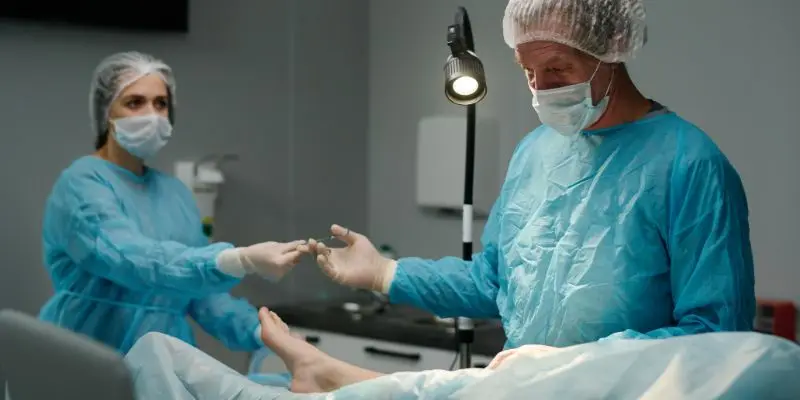
Sometimes, Haglund's disease persists. If conservative treatment isn't enough and the heel pain persists, it's time to consider surgery. Don't worry, surgeons have modern and often painless techniques to solve the problem.
Common surgical techniques
Some of the most commonly used techniques to defeat Haglund's Disease are:
- Removal of prominent bone: this involves the removal of the bony “hump” that causes irritation.
- Osteotomy: If the bone is the real culprit, a small cut may be used to realign it.
- Decortication of the Achilles tendon: a tendon clean to avoid further stress and inflammation.
The procedure usually does not take a full day. On average, it lasts about an hour , and can often be performed as a day case.
Possible post-operative complications
As with all surgical procedures, Haglund's disease surgery carries risks. Here are the most common complications:
- Infections: although rare, some germs may infect the wound.
- Residual pain: Haglund's disease sometimes leaves painful after-effects, which can be resolved with anti-inflammatories and painkillers.
Book your visit with SmartHallux

Haglund's disease can turn every step into a nightmare. SmartHallux can help you return to living peacefully. Thanks to the innovative, minimally invasive technique , we can permanently solve your problem. Don't let heel pain limit your daily activities. With SmartHallux, you can finally say goodbye to pain and walk with peace of mind again. Book a consultation now using the booking form on our website . Find out how SmartHallux can help you rediscover the pleasure of pain-free walking. Don't let Haglund's disease stop you, book now!