
Haglund's disease surgery: outcomes in children and adults
Haglund's disease surgery in children and adults: how the approach differs with age, when it is advised and what the outcomes are.
By Dr. Luigi ManziUpdated on
Surgery for Haglund's disease is a matter that affects both young and adult patients. In infants, this condition presents as osteochondrosis , characterized by the presence of an exostosis on the posterior aspect of the calcaneus.
This type of osteochondrosis is a condition that affects both bone and cartilage and, for reasons still unknown, causes degeneration in these areas. Simply put, this disorder strikes during the growth phase.
In children with this condition, the natural ossification of the growth plate is often disrupted . Think of cartilage as a sort of miniature factory that produces bone: when something goes wrong, these factories begin to malfunction, resulting in disorganized and sometimes pathological bone production.
Among the prominences that can form, one of the most common is that linked to Osgood-Schlatter syndrome , which affects the anterior tibial process . Similarly, in Haglund's disease, the problem lies in the bone production of the posterior process of the calcaneus , giving rise to the so-called Sever-Blanke-Haglund disease.
Despite its self-limiting nature, this condition can be completely asymptomatic in children . When symptoms do appear, they often manifest as pain during sports. However, there's no need to prohibit young athletes from physical activity: rest and attention are sufficient when the pain occurs.
Haglund's disease surgery: the approach in adults

In adults, doctors often find themselves treating the consequences of Haglund's disease dating back to childhood. In these individuals, the condition manifests as an anatomical alteration of the heel . The excess bone, known as exostosis , can lead to increased friction with adjacent soft tissues and with footwear. For example, this bony protrusion impinges on the Achilles tendon and the retrocalcaneal bursa , causing pain.
Wearing closed, rigid shoes can worsen the condition, causing uncomfortable rubbing that aggravates the symptoms. Adults with this condition often have to limit their sports activities. Furthermore, in severe cases, even everyday tasks like walking or climbing stairs can become problematic due to the pain.
Haglund's disease: diagnosis and treatment
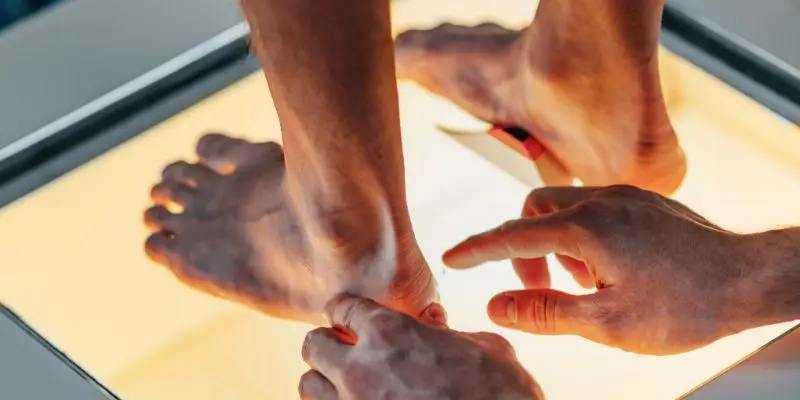
To correctly diagnose Haglund's disease , a clinical examination is essential. Usually, the expert looks for a swelling on the posterior aspect of the heel , near the insertion of the Achilles tendon, which very often causes pain. Sometimes, it can be limited to the calcaneal tuberosity , which appears enlarged due to the presence of a significant exostosis.
Weight-bearing X-rays are the first-line diagnostic method, useful for confirming the diagnosis and identifying any intratendinous calcifications . Ultrasound can be useful for assessing the extent of Achilles' heel involvement. However, magnetic resonance imaging remains the most accurate test for analyzing soft tissue and is usually requested in specific cases, such as when non-insertional tendinopathy is suspected.
Although conservative treatment is always the most appropriate, the results obtained with this approach are often disappointing for this condition. Patients may be forced to modify or abandon their sports habits and choose footwear that is less aggressive towards the exostosis. Physical therapies such as Tecar therapy , massage therapy , and triceps surae stretching undoubtedly offer relief, but for most patients, they are not definitive solutions.
Contact SmartHallux for Haglund's Disease

When conservative treatment fails, surgery for Haglund's disease becomes necessary. Surgical removal of the exostosis relieves pain and improves the patient's quality of life. Postoperative recovery can require time and physical therapy, but it usually yields excellent results in both children and adults. The modern techniques used by the SmartHallux team of experts ensure excellent surgical success and rapid postoperative recovery. To schedule an appointment, click here.