
From lasers to robotics: advanced technologies for surgical interventions for Haglund's disease
Haglund's disease causes heel pain; when creams and insoles aren't enough, it's time for advanced technologies, from lasers to robotics, to solve the problem.
By Dr. Luigi ManziUpdated on
Haglund's disease is a condition that affects the heel. The resulting bony protrusion causes inflammation and pain . When creams and insoles are ineffective, it's time to turn to cutting-edge surgical technologies , from laser to robotics. Let's take a look at how lasers and robotics are solving this problem.
What is Haglund's Disease?

As we were saying, Haglund's disease is a bony protuberance that forms on the back of the heel , right where the Achilles tendon meets the calcaneus.
Anatomically speaking, this condition develops when the heel bone becomes more prominent, creating friction with shoes and leading to inflammation and pain. Haglund's disease is immediately noticeable. Its main symptoms include:
- pain, especially in the back area of the heel;
- swelling, which turns the back of the ankle into a little balloon;
- redness.
Diagnosis usually begins with physical examination, followed by X-rays to confirm the presence of the bony prominence.
The use of laser in surgery for Haglund's disease
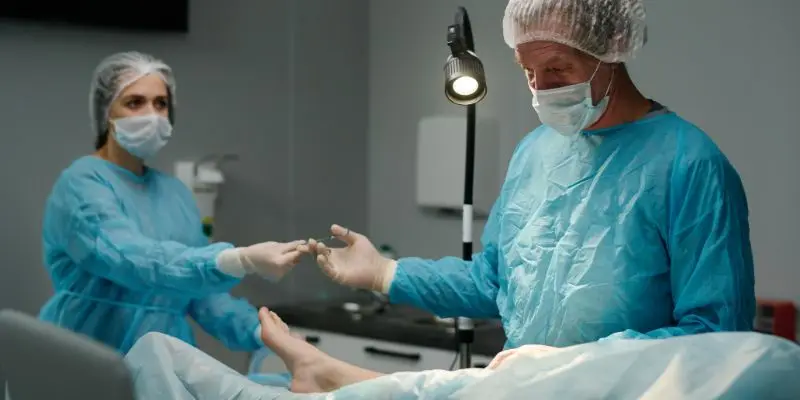
Once Haglund's disease has been definitively diagnosed, advanced technology comes into play with the use of lasers in Haglund's disease surgery . By emitting a highly focused beam of light , it can cut, vaporize, or "shape" the affected tissue with extreme precision.
The advantages of using laser technology in surgery for Haglund's disease include:
- Precision: millimetrically perfect cuts.
- Less tissue trauma: the laser leaves the surrounding areas intact.
- Faster recovery: less damage means faster recovery.
Success stories in the use of laser

The effectiveness of laser surgery for Haglund's disease has been widely attested. Several patients have shared their experiences: the previously painful sensation quickly became a distant memory. Many people, thanks to the laser's precision, have been able to resume their daily activities.
In short, this surgical treatment really manages to put an end to the pain, allowing you to return to your normal everyday life.
The use of robotics in surgery for Haglund's disease
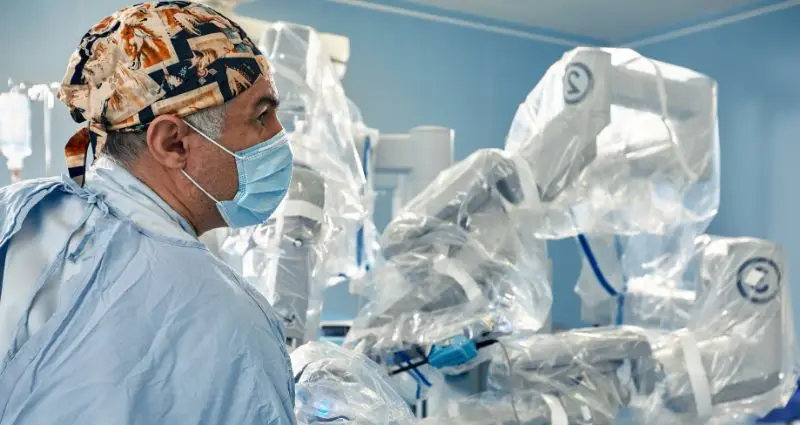
When we talk about surgical robotics , we're referring to machines that move with grace and precision. These systems are equipped with articulated arms that mimic the movements of human hands with astonishing accuracy. The instruments are miniaturized to minimize trauma to healthy tissue. The surgeon is the director behind the scenes, using a computer console to move the robotic instruments, observing everything in high definition through a 3D screen.
Advantages of using robotics in surgery
The benefits of integrating robots into the operating room are numerous. Here are some of the most acclaimed:
- Millimetric precision: Robots are able to make tiny incisions, minimizing the risk of human error.
- Faster recovery: Less invasive procedures often mean shorter recovery times for patients.
- Less post-operative pain: with less trauma to surrounding tissues, patients experience less pain after surgery.
Supporting studies and research
By now, robotic systems have earned a place not only alongside surgeons, but also in research textbooks. Several studies demonstrate the effectiveness of robotics in surgery : for example, a recent study showed a 30% reduction in post-operative complications compared to traditional methods. This is certainly no small achievement. With such results, it's clear why robotics is becoming an increasingly standard technology in leading hospitals around the world.
Book your appointment with SmartHallux

Trust SmartHallux to treat Haglund's disease with the most advanced technologies. If you suffer from heel pain and inflammation, it's time to say no. SmartHallux uses cutting-edge surgical techniques such as laser and robotics to offer you a precise and minimally invasive solution.
Thanks to the precision of the laser, healthy tissue is preserved, ensuring a quick and less painful recovery. Robotics, with its miniaturized instruments, allows for millimetric incisions and reduces the risk of post-operative complications . Don't let pain limit your daily life. Book a consultation with our experts now using the booking form on the website . With SmartHallux, you'll be able to walk pain-free again and live every day to the fullest.