
Hallux valgus and X-rays: everything you need to know for an accurate diagnosis
To understand how serious a bunion is and whether treatment or surgery is needed, an X-ray is the starting point.
By Dr. Luigi ManziUpdated on
Have you noticed a painful bump at the base of your big toe? Or does your toe seem to be increasingly deviating toward the other toes? You may be dealing with a hallux valgus , one of the most common foot deformities. But to determine how serious it is and whether treatment or surgery is necessary, an X-ray is the best place to start.
With this article, we want to explain in a simple yet precise way when it is useful to have an X-ray for hallux valgus , what it actually shows and how to guide the specialist towards the right treatment.
What is hallux valgus?
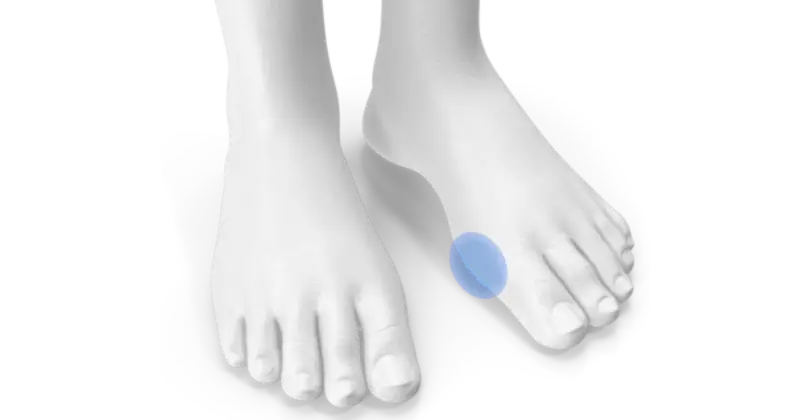
Hallux valgus is a progressive foot deformity in which the big toe deviates laterally, toward the other toes. This deviation causes a bony protrusion, often painful and inflamed, also known as a "bunion." The cause may be genetic, related to tight shoes or high heels, poor foot placement, or conditions such as flat feet.
Over time, the condition not only worsens the appearance of the foot, but can make walking, wearing shoes, and performing daily activities painful.
When is an X-ray necessary?

Hallux valgus X-rays are used to assess the degree of joint deviation and the condition of the metatarsophalangeal bones. This simple, quick, and painless examination allows the specialist to see exactly how much the toe is rotated or misaligned , and whether there is any associated arthritis, joint changes, or other signs of degenerative changes.
Compared to a visual or palpatory assessment, the hallux valgus x-ray (another way of saying x-ray) provides objective and indispensable information, especially in view of an operation.
Diagnosis and Treatment: What to Expect After the Exam

After performing a foot X-ray for hallux valgus , the specialist will be able to determine the most appropriate strategy. If the deformity is mild, conservative treatments can be used : comfortable, wide-soled shoes, insoles, nighttime orthotics, and targeted physiotherapy.
If the pain is constant, the foot is severely deformed, or the condition limits daily life, surgery is considered . Modern techniques, such as those used by Dr. Luigi Manzi at SmartHallux, are minimally invasive , heal quickly, and offer excellent correction precision.
SmartHallux: The right step starts with a correct diagnosis

If you suspect you have a bunion or if the pain limits your daily activities, don't wait. A simple X-ray can clarify the situation and help you choose the most appropriate treatment for your case.
The SmartHallux team treats conditions such as hallux valgus , Morton's neuroma , and other deformities that cause foot pain. Providing comprehensive support throughout the treatment process, SmartHallux can be a winning choice for effective treatment tailored to your needs. Book your specialist consultation with the SmartHallux team now (opens in a new tab).
FAQ
Is an X-ray always necessary to diagnose hallux valgus?
Yes, especially if surgery is suspected or if the pain is chronic. It helps assess the exact degree of deformity.
Is it painful?
Absolutely not. It's a quick, non-invasive, and very useful test.
How much does a SmartHallux X-ray visit cost?
The cost is reasonable compared to the national average and can be partially covered by insurance. The initial consultation can be done online or at one of the affiliated centers in Italy.